


Under the “carbon neutrality” policy, logistics providers are helping to advance China’s efforts toward “low-carbon logistics” and “smart logistics.”
Release date:
2021-10-11
Author:
Jinhua Logistics
On September 21, President Xi Jinping attended the General Debate of the 76th Session of the United Nations General Assembly via video link from Beijing, announcing that “China will vigorously support the green and low-carbon energy development of developing countries and will no longer initiate new coal-fired power projects abroad,” thereby further underscoring China’s commitment to implementing its carbon neutrality policy. ... ...
On September 21, President Xi Jinping of the People’s Republic of China… Beijing Delivering a video address to the General Debate of the 76th Session of the United Nations General Assembly, China announced that it will “strongly support the green and low‑carbon energy development of developing countries and will no longer initiate new coal‑fired power projects abroad,” thereby further underscoring its commitment to implementing its carbon‑neutrality policy.
China is vigorously promoting energy conservation and emissions reduction. As one of the pillar industries driving national economic development, the logistics sector is also accelerating its transition toward low-carbon and green practices, leveraging modern technologies to build a green supply-chain circulation system and achieve sustainable, efficient, and smart logistics.
In the era of the digital economy, the logistics industry is transitioning toward low-carbon and green practices by leveraging internet and big data technologies to enhance its level of informationization and digitalization. This enables intelligent, automated operations, digitalized management, improved operational efficiency, and reduced energy consumption—making it the preferred path for many enterprises.
Logistics Source operates under the philosophy of “Technology in Logistics, Logistics through Technology,” with environmental sustainability and green practices at its core. It is dedicated to providing upstream and downstream logistics enterprises with professional, high‑efficiency information‑collaboration platforms and digital, paperless solutions. By managing the entire end-to-end workflow—including order management, in‑transit transportation, exception monitoring, and reconciliation and settlement—Logistics Source enhances operational efficiency, reduces energy consumption and carbon emissions, and lowers paper‑related costs.
Efficient collaboration to enhance operational efficiency.
The logistics supply chain encompasses numerous operational stages and participating stakeholders. The efficiency of each stage and role is seldom confined to its own performance; rather, it is largely determined by the degree of seamless integration and collaboration among them. Logistics Yuan offers free enterprise‑level logistics solutions, building an intelligent, efficient, and information‑driven collaborative platform that streamlines information flows between key elements and across touchpoints, seamlessly connecting all links in the logistics process, coordinating upstream and downstream operations, enhancing supply chain collaboration, eliminating redundant nodes, and achieving holistic optimization.
The logistics‑source efficiency‑collaboration platform also streamlines internal logistics operations, enabling standardized management of logistics orders, online contract quoting, intelligent dispatching, smart pricing, and automated reconciliation and settlement. This intelligent, automated approach to logistics management simplifies workflows, reduces labor costs, and boosts overall operational efficiency.
Strictly control transit times to help eliminate excess inventory.
To achieve green logistics—eliminating excess inventory, reducing resource consumption, and lowering carbon emissions—companies must rigorously manage inventory levels. This, in turn, requires seamless, end-to-end logistics that keep pace with production and sales, while maintaining strict timeliness throughout the transportation process.
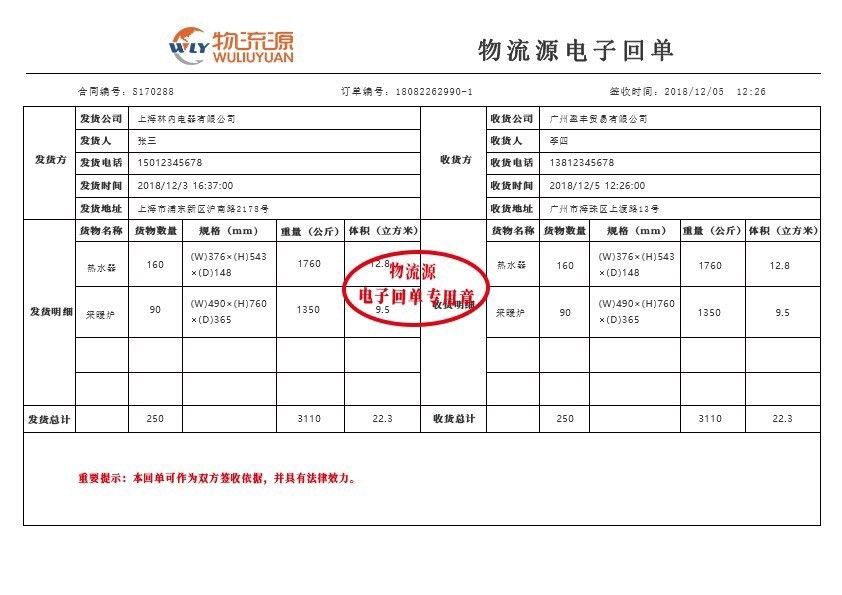
Logistics Source Integrated with Smart Electronic Devices — Electronic Delivery Receipt In the transportation phase, it accurately tracks and records cargo‑related information, including shipment trajectory, location, dwell time, estimated time of arrival, and delivery confirmation status. This data is displayed in real time on large TV screens, computers, and WeChat, enabling all stakeholders in the logistics chain to achieve end-to-end visibility and transparent control over the entire transport process. In the event of delays or anomalies, timely alerts are triggered, ensuring rigorous compliance monitoring and precise oversight of transit times—thereby helping enterprises improve inventory turnover and reduce stock levels.

Digital operations, enhanced operational efficiency
While building enterprise information systems and enhancing upstream–downstream collaboration, Logistics Source has further leveraged big data and artificial intelligence to establish a digital operations framework, enabling the digitized management of logistics documents such as contracts, orders, and delivery receipts, thereby further improving logistics operational efficiency.
At the same time, real-time collection of logistics data is enabled, allowing for data accumulation. Through persistent data storage, in-depth data mining, and advanced analytics, multi-dimensional operational analysis reports are automatically generated. This empowers managers to gain real-time visibility into the company’s logistics operations, optimize cost and operational management, select optimal carriers, and standardize transportation protocols—thereby continuously improving logistics efficiency, reducing transportation costs, and minimizing waste.
Paperless logistics reduces paper waste.
Logistics documents and delivery confirmations are paperless. Logistics informatization and digitalization facilitate the online transmission and digital management of enterprise logistics documents, paving the way for paperless circulation. The electronic receipt‑scanning and signature‑confirmation feature enables electronic acknowledgment and generates legally valid electronic receipts, ensuring the security of both delivery confirmation and receipt submission while further advancing the move toward paperless processes. This achieves secure, efficient, and fully paperless logistics operations throughout the entire supply chain, reducing paper waste and circulation costs, and minimizing the consumption of non‑renewable resources.
Legal safeguards for paperless logistics. Meanwhile, two national‑level, financial‑grade institutions—the China Financial Certification Authority and the National Time Service Center of the Chinese Academy of Sciences—provide services such as electronic certification, digital certificates, electronic signatures, and timestamps. In addition, the electronic logistics contracts executed on the logistics source platform carry the same legal validity, thereby offering robust legal safeguards for the promotion of paperless logistics.
Today, the concept of environmental protection has permeated the development of every sector in China. Building green logistics supply chains, embracing the “dual carbon” goals, and achieving “low-carbon” and “smart” logistics will also become key drivers for the industry’s sustainable growth. Logistics Yuan will continue to explore cutting-edge science and technology, applying them flexibly across the logistics field to advance the cause of green logistics.
Recommendation


Leave a message for inquiry
Our customer service department can provide you with information and answer your questions, and you can also visit our FAQ section.